

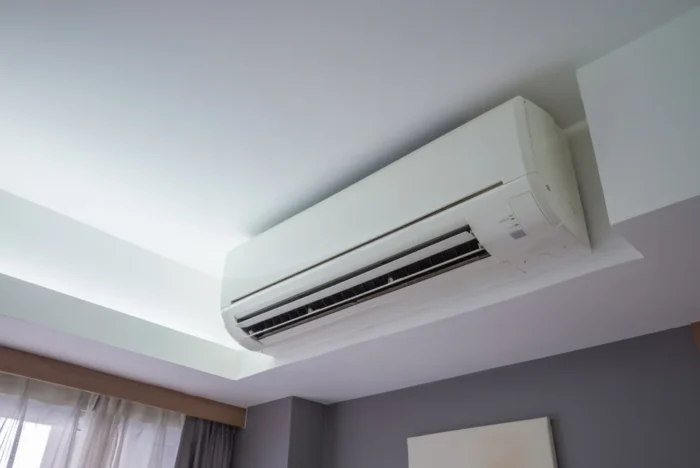
Sizing an air conditioner isn’t just about pickings a unit that fits in your window; it’s about balancing cooling capacity with your home’s specific environment. If a unit is too small, it will run constantly without ever cooling the room. If it is too large, it will cycle on and off so quickly that it fails to remove humidity, leaving your space feeling clammy.
Finding the answer to what size air conditioner do i need involves looking at your square footage, ceiling height, and local climate. At MileHi HVAC, we see many homeowners struggle with high energy bills simply because their unit wasn’t sized correctly for the Denver heat.
Why Choosing the Right AC Size Matters
Buying an air conditioner is a significant investment in your home’s infrastructure. A unit that is improperly sized leads to premature wear and tear. When a system is too powerful for a small space, it “short cycles.” This means it turns on and off in rapid bursts, which spikes your electricity usage and prevents the system from dehumidifying the air.
On the other hand, an undersized unit creates a different problem. It will work at maximum capacity all day long but will never reach the temperature you set on the thermostat. This leads to frozen coils and a shortened lifespan for the motor. Getting the capacity right ensures your home stays dry and cool while keeping your monthly costs low.
How to Calculate the AC Size You Need
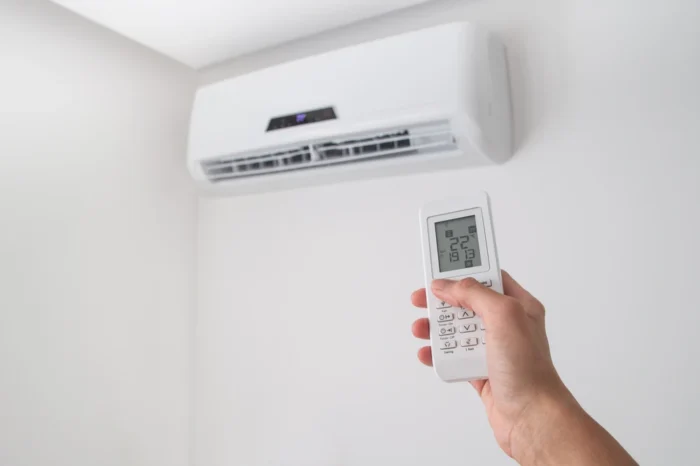
The starting point for any AC sizing calculation is your room’s square footage.
Step 1: Measure your space Multiply the length of the room by its width. A 15 x 20 foot room equals 300 square feet.
Step 2: Apply the BTU baseline The U.S. Department of Energy recommends roughly 20 BTUs per square foot of living space. So that 300 sq ft room needs about 6,000 BTUs.
Step 3: Adjust for your conditions
- Add 10% BTUs if the room gets a lot of direct sunlight
- Subtract 10% BTUs if the room stays shaded most of the day
- Add 600 BTUs for each additional person who regularly uses the space beyond two
- Add 4,000 BTUs if you are cooling a kitchen
Step 4: Account for ceiling height Standard formulas assume 8-foot ceilings. If yours are taller, add 1,000 BTUs for every foot above 8 feet.
These adjustments are simple but they make a real difference in your final number.
Read More: Air Conditioning Mistakes To Avoid At All Costs.
Understanding BTU Ratings and Room Sizes
Knowing what capacity ac do i need requires matching BTUs to your specific room dimensions. Use the table below as a general guide for residential spaces:
| Room Square Footage | Cooling Capacity Needed (BTUs) | Common AC Tonnage |
| 150 to 250 sq. ft. | 6,000 BTUs | 0.5 Ton |
| 300 to 450 sq. ft. | 10,000 BTUs | 0.8 Ton |
| 500 to 700 sq. ft. | 14,000 BTUs | 1.2 Tons |
| 700 to 1,000 sq. ft. | 18,000 BTUs | 1.5 Tons |
| 1,000 to 1,200 sq. ft. | 21,000 to 24,000 BTUs | 2.0 Tons |
What Size AC Do I Need for Common Spaces?
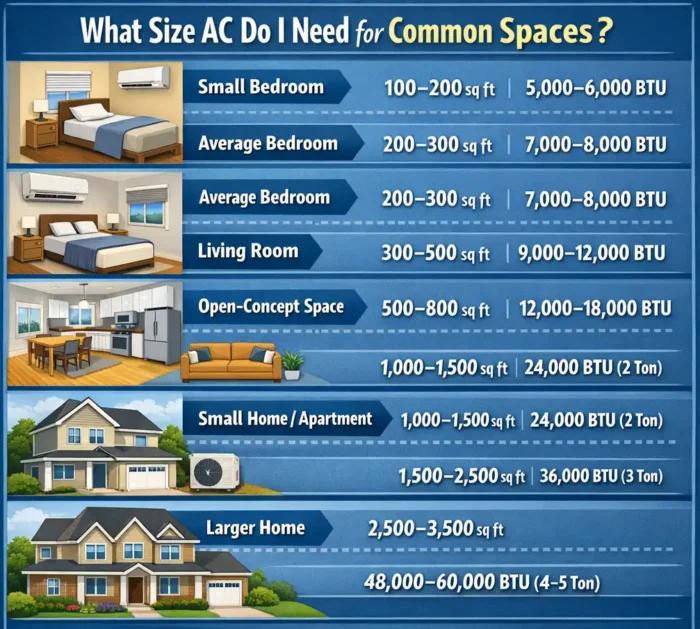
Here is a practical breakdown for the most common areas people ask about:
Small bedroom (100–200 sq ft): A 5,000 to 6,000 BTU window or portable unit works well here.
Average bedroom (200–300 sq ft): Go with 7,000 to 8,000 BTU. This handles a queen or king bed setup comfortably.
Living room (300–500 sq ft): A 9,000 to 12,000 BTU mini split or window unit is ideal for this range.
Open-concept space (500–800 sq ft): Plan for 12,000 to 18,000 BTU. Open floor plans allow heat to spread, so you need more capacity.
Small home or apartment (1,000–1,500 sq ft): A 2-ton (24,000 BTU) central system or multi-zone mini split covers this well.
Average home (1,500–2,500 sq ft): A 3-ton (36,000 BTU) central system is a common fit here.
Larger home (2,500–3,500 sq ft): A 4 to 5-ton central system is usually required.
These are general guides. Your actual needs depend on insulation quality, local climate, and other factors specific to your home.
Different Types of AC Units and Their Sizing
When you understand what capacity AC you need, the next step is choosing the right type of unit. Each type has different sizing considerations.
Window Air Conditioners Best for single rooms. They range from 5,000 to 25,000 BTU. Easy to install but only cool one space at a time. Not ideal for rooms larger than 500 sq ft.
Portable Air Conditioners These sit inside the room and vent hot air through a window hose. They are labeled with a BTU rating, but note that portable units are less efficient than window units. A 14,000 BTU portable AC may only deliver around 7,000 to 8,000 BTU of actual cooling due to heat re-entering from the exhaust hose.
Mini Split (Ductless) Systems Mini splits are growing in popularity because they cool individual zones without ducts. They range from 9,000 BTU for small rooms to 36,000 BTU for large open spaces. They are efficient, quiet, and highly effective for homes without existing ductwork.
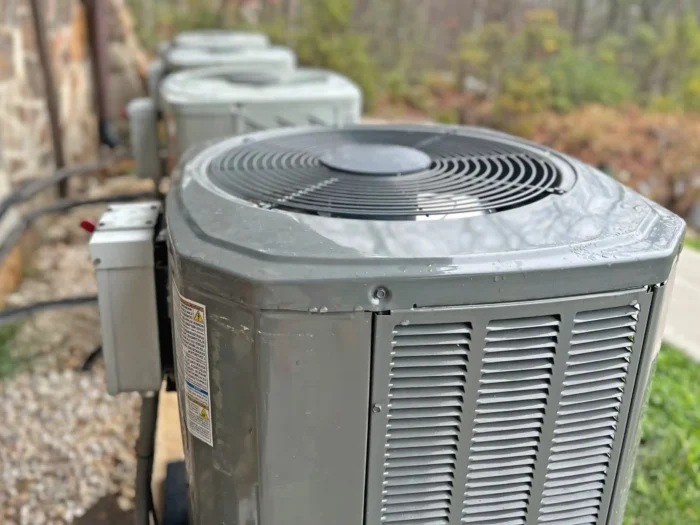
Central Air Conditioning Central systems cool the entire home through ducts and a single outdoor unit. Sizing for central AC uses tons rather than BTUs. A professional load calculation, called a Manual J, is the most accurate way to size a central system.
Climate and Local Conditions That Affect AC Size
Where you live matters just as much as how big your space is.
Denver sits at a mile above sea level. The thinner air at altitude changes how HVAC systems perform. Heat here builds quickly during summer days but drops fast at night, which affects how your system cycles.
Homes with older windows, minimal attic insulation, or south-facing walls absorb more heat and need more cooling capacity. Newer, well-insulated homes can often get away with a smaller system.
If your home has large open windows, high ceilings, or is located in a sunny western exposure, factor those things into your BTU estimate.
Common Mistakes to Avoid When Sizing Your AC
- Only using square footage Square footage is your starting point, not your final answer. Ceiling height, sun exposure, and insulation all change the number.
- Assuming bigger is better Oversizing is a real problem. It leads to short cycling, poor dehumidification, and a system that wears out faster.
- Ignoring the type of unit Portable AC units are rated differently than window or split systems. A 12,000 BTU portable does not cool the same as a 12,000 BTU mini split.
- Skipping a professional load calculation Online estimates are helpful guides. But for central systems, a Manual J calculation done by a licensed technician is the most accurate way to size your system.
- Not accounting for kitchen heat Kitchens generate a lot of extra heat. If your AC serves a kitchen or open-plan kitchen-living area, add at least 4,000 extra BTUs.
When to Call a Professional
Some situations call for more than a calculator.
If you are replacing a central AC, switching from window units to a whole-home system, or if you live in a climate with big temperature swings like Denver, a professional assessment is worth it.
A licensed HVAC technician will look at your home’s insulation, ductwork, window count, local climate data, and sun orientation. They use that data to give you a precise recommendation instead of a rough estimate.

Conclusion
Getting the right AC size comes down to three things: measuring your space, applying the BTU formula, and adjusting for your specific conditions. The goal is a system that runs efficiently, cools evenly, and lasts for years. If you are unsure, do not guess. A wrong choice costs more in energy bills and repairs than a professional consultation ever would. MileHi HVAC specializes in air conditioning installation in Denver and can help you find the perfect fit for your home. Reach out today and get a free sizing consultation from our team.
Frequently Asked Questions
What size air conditioner do I need for a 1,000 sq ft home?
A 1,000 sq ft home typically needs around 18,000 BTU or a 1.5-ton system. Adjust up if your home has poor insulation or a lot of sun exposure.
How do I know what size AC unit I need for a single room?
Multiply the room length by the width to get square footage, then use 20 BTU per square foot as your baseline. Adjust for sunlight, people, and ceiling height.
Is a 2-ton AC enough for a 1,500 sq ft house?
A 2-ton unit delivers 24,000 BTUs, which is generally enough for a well-insulated 1,200 to 1,500 sq ft home. In hotter climates or older homes, a 2.5-ton may serve better.
Does air conditioner size affect humidity control?
Yes. An oversized AC shuts off before it can remove enough moisture. A properly sized unit runs long enough to dehumidify, which is just as important as temperature control.
What is a Manual J calculation?
It is a professional load calculation that accounts for your home’s size, insulation, windows, local climate, and more. It is the gold standard for sizing central AC systems.
Can I use the same BTU chart for mini splits and window units?
The BTU-to-room-size chart works for both, but keep in mind that mini splits are more efficient. You may be able to use a slightly smaller BTU mini split compared to a window unit for the same room.