

If your home feels warm, you might wonder if your cooling system is failing. Knowing how cold should ac air be helps you decide if you need a professional repair. A healthy air conditioner does not just blow “cold” air; it removes heat from your indoor space.
The temperature of the air leaving your vents depends on the air going into the system. Most systems are designed to drop the temperature by a specific range. Understanding this range is the first step to checking your system performance. MileHi HVAC provides this guide to help you troubleshoot your cooling at home.
Key Takeaways
- AC vents should blow air between 15°F and 20°F cooler than the return air
- Ideal vent air temperature is typically between 50°F and 55°F
- A temperature differential below 14°F usually signals a problem
- High humidity, dirty filters, and low refrigerant are common causes of poor cooling
- Always measure both supply and return air to get an accurate reading
How Cold Should Your Air Conditioner Be Venting? (Temperature Levels Explained)
Most homeowners think an AC works like a refrigerator by creating coldness. In reality, it uses refrigerant to soak up heat from your home and dump it outside. Because of this, the output temperature is relative. If your home is 80 degrees, the air coming out of the vents should be between 60 and 65 degrees.
If the air is much warmer than that, the system might have a refrigerant leak or a failing compressor. If the air is significantly colder, you might have restricted airflow. This can cause the coils to freeze, which stops the cooling process entirely.
Ideal Temperature for Air Coming Out of Your AC Vents
When asking how cold should ac air be, the industry standard is the 20-degree rule. This means the air exiting the supply vent should be roughly 20 degrees lower than the air entering the return vent. This is why a house at 75 degrees feels different than a house starting at 85 degrees.
| Room Temperature | Target Vent Temperature |
| 70°F | 50°F – 55°F |
| 75°F | 55°F – 60°F |
| 80°F | 60°F – 65°F |
If your system consistently hits this 20-degree gap, it is likely in good health. However, extreme humidity in places like Denver can make the air feel less cold because the system is busy removing moisture rather than just lowering the temperature.
What Is Supply and Return Air?
Before measuring anything, it helps to understand the two types of air in your system.
Supply air is the cooled air your AC pushes out through vents into your rooms. These are the vents you feel cool air blowing from.
Return air is the warm room air that gets pulled back into the AC system to be cooled again. Return vents are usually larger and do not blow air. They pull it in.
The temperature differential is measured by comparing return air temperature to supply air temperature. If your return air is 76°F and your supply air is 57°F, your delta T is 19°F. That is a healthy system.
Knowing this difference helps you and any HVAC technician quickly figure out if your system is cooling efficiently.
How to Check the Air Temperature Differential Accurately
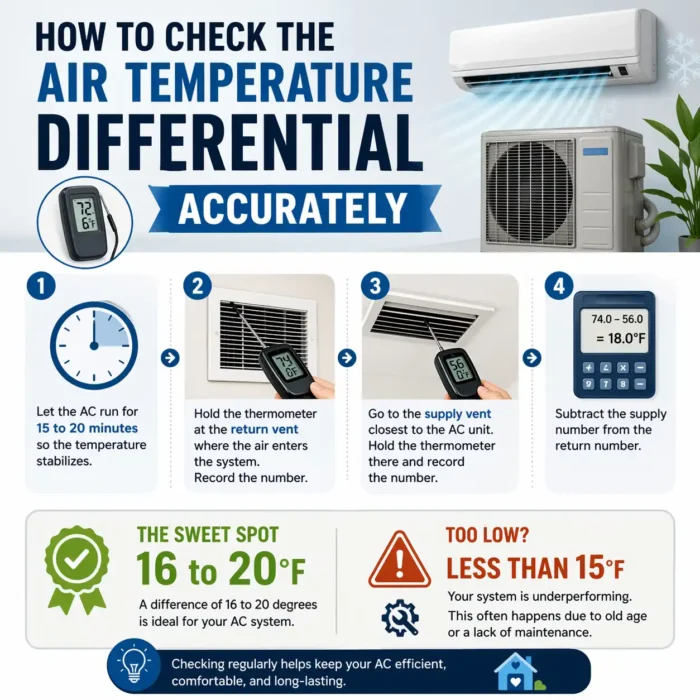
To see how cold should my ac blow, you need a simple digital thermometer. Follow these steps for an accurate reading:
- Let the AC run for at least 15 to 20 minutes so the temperature stabilizes.
- Hold the thermometer at the return vent where the air enters the system. Record the number.
- Go to the supply vent closest to the AC unit. Hold the thermometer there and record the number.
- Subtract the supply number from the return number.
A difference of 16 to 20 degrees is the “sweet spot.” If the difference is less than 15 degrees, your system is underperforming. This often happens due to old age or a lack of maintenance.
Read More: What Size Air Conditioner Do I Need For My Space?
Do All ACs Have the Same Temperature Differential?
Standard central air units and mini-split systems generally follow the same rules for what temp should ac blow. However, older systems might struggle to maintain a 20-degree drop during a record-breaking heatwave.
Systems with variable-speed compressors might also show different numbers. These units adjust their output based on the cooling demand. They might blow air that is only 10 degrees cooler if the home is already close to the target temperature. This is normal behavior meant to save energy.
What If You Have Big Differences in the Vent Temperatures?
Uneven temperatures between vents are a common complaint. One room feels cold and another feels warm, even with all vents open.
Here are the main causes:
Duct leaks: Air escapes before it reaches distant vents. Rooms far from the air handler often feel warmer.
Blocked or closed vents: Furniture placed over vents restricts airflow and causes uneven cooling.
Dirty air filter: A clogged filter reduces total airflow, which lowers the delta T and makes some rooms underserved.
Low refrigerant: Low refrigerant reduces the system’s ability to absorb heat. This brings vent temperatures up and can cause ice buildup on the coil.
Oversized or undersized AC: A system that is too large for your home will short cycle, meaning it turns off before properly distributing cool air. A system too small will run constantly and never catch up.
If you notice a delta T below 14°F, check the air filter first. Replace it if it is dirty. If the problem continues, it is time to have a technician check refrigerant levels and inspect the evaporator coil.
Rooms with poor cooling may also point to zoning issues or duct problems that need professional diagnosis.
Why Outdoor Temperature Affects Your Vent Output
On very hot days, you may notice your AC blowing air that feels less cold than usual. This does not always mean something is wrong.
When outdoor temperatures exceed 95°F, the condenser unit outside struggles to release heat efficiently. This reduces the overall system efficiency and can raise supply air temperatures by a few degrees.
Most AC systems are designed to maintain an indoor temperature 20°F to 25°F below the outdoor temperature. So if it is 100°F outside, your system is designed to hold about 75°F to 80°F indoors. That is its design limit, not a flaw.
If your system cannot maintain comfort when it is 85°F outside, that is when to investigate further.

When to Call a Professional
Some temperature issues are simple fixes. Others need a trained HVAC technician.
Call a professional if:
- Your delta T is below 12°F after replacing the filter
- You see ice forming on the refrigerant lines or coil
- Your AC runs constantly but does not cool the home
- Vent temperatures vary wildly from room to room
- Your system is over 12 years old and has not been serviced recently
MileHi HVAC offers Denver air conditioner installation service and full diagnostic checks for homeowners experiencing cooling problems. Whether it is a refrigerant issue, duct leak, or an aging system, getting a professional evaluation can save money over time.
Conclusion
A healthy AC system blows air that is 15°F to 20°F cooler than the air it pulls in. Vent temperatures should typically fall between 50°F and 55°F. If your system falls outside that range, start with the basics: check the filter, look for blocked vents, and measure the delta T yourself. Most problems are fixable before they become expensive. If you are in the Denver area and need a second opinion, MileHi HVAC is ready to help. A properly working AC is not a luxury. It is a home essential.
FAQs
How cold should my ac blow from vents?
Supply air from AC vents should be between 50°F and 55°F in most homes. The key measure is a 15°F to 20°F drop from the return air temperature.
What does delta T mean for AC systems?
Delta T is the temperature difference between return air and supply air. A healthy range is 15°F to 20°F.
Why is my AC running but not blowing cold air?
Common causes include a dirty air filter, low refrigerant, a frozen evaporator coil, or a failing compressor. Start by replacing the filter.
What temp should air be coming out of vents on a hot day?
On very hot days (above 95°F), vent air may be slightly warmer than usual. A delta T of 14°F to 17°F is still acceptable under those conditions.
Can high humidity affect vent temperature?
Yes. High humidity forces the AC to remove more moisture, which uses cooling capacity and can raise vent temperatures slightly.
How often should AC systems be serviced?
Once a year, ideally in spring before cooling season begins. Regular maintenance keeps delta T in the healthy range and extends system life.