


Here’s something most homeowners don’t realize until they see their winter electric bill — your gas furnace uses electricity every single time it kicks on. The gas handles the heat, but electricity runs the blower fan, the igniter, and the control board that keeps everything working. No electricity means no heat, even with a full gas line.
So how many watts does a gas furnace use? For most homes, it falls between 400 and 1,200 watts while running. That number matters more than you’d think — it determines whether your generator will actually keep you warm during a Denver power outage and explains why your electric bill quietly climbs every winter. In this guide, we’ll break down the real numbers, what’s drawing that electricity, and how to calculate exactly what your furnace is costing you each month.
Average watts of a gas furnace
A standard gas furnace normally uses 400 to 1200 watts while running. However many homes have furnaces in the 600 to 800 watt range. But this wattage depends upon different variables like furnace size, efficiency rating and blower motor.
In gas furnaces gas is used as primary source for giving heat and electricity is used for some elements like ignition, airflow and safety concerns. So this system is known as gas furnace wattage which is typical at lower level than electrical heating systems.
Electrical Components and their power use
| Component | wattage | purpose |
| Blower motor | 300–750 watts | Moves warm air |
| Ignition System | 80–120 watts | Lights burners |
| Control Board | 20–50 watts | Manages heating cycle |
| Draft Inducer | 50–100 watts | Vents exhaust |
| Transformer | 10–20 watts | Powers thermostat |
Keep this thing in mind that startup wattage is higher than running wattage. When the furnace starts it draws 1.5 to 2 times than normal operating power. So consider this factor while choosing a backup generator.
At Milehi Hvac, we see many homeowners surprised by their furnace’s electrical needs. Our furnace installation services in Denver include detailed power consumption analysis to help you choose the most efficient system for your home.
Gas Furnace Wattage by Size and BTU Rating

As gas furnace wattage depends upon various factors so gas furnace electricity usage directly depends upon the furnace size. Lager furnaces typically require more powerful blowers which leads to increase in electrical consumption.
BTU and wattage of furnaces
- 40,000-60,000 BTU have wattage of 400-600 watts.
- 60,000-100,000 BTU have wattage of 600-900 watts.
- 100,000-150,000 BTU have wattage of 900-1200 watts.
So high efficiency furnaces which have AFUE ratings above 90% often use variable speed ECM blower motors. These types of motors also reduces electrical demand by 30-50 percent
Average Wattage by Furnace Type
Comparing different heating systems shows why gas furnaces are energy-smart.
| Heating System | Wattage Range | Energy Source |
| Gas Furnace | 400-1,200 watts | Natural gas + electricity |
| Electric Furnace | 10,000-50,000 watts | Electricity only |
| Oil Furnace | 800-1,400 watts | Heating oil + electricity |
| Heat Pump | 3,000-5,000 watts | Electricity only |
| Propane Furnace | 400-1,200 watts | Propane + electricity |
Gas furnaces offer the best balance. They use 400-1,200 watts of electricity while natural gas provides the actual heat. The gas furnace wattage stays relatively low because electricity only powers auxiliary systems.
Electric furnaces are power-hungry. They consume 10,000-50,000 watts because electricity generates all the heat. A typical 15,000-watt electric furnace costs significantly more to operate than a comparable gas unit.
You may read How Long Does A Gas Furnace Last?
How Maintenance Directly Affects How Much Electricity Your Furnace Uses
Most homeowners think of furnace maintenance as a safety thing — and it is. But there’s a side nobody talks about: a dirty, neglected furnace pulls significantly more electricity than a clean one. We’ve seen this firsthand servicing Denver homes. Here’s exactly how much each common issue adds to your electrical draw:
| Maintenance Issue | Extra Watts Drawn | Annual Cost Impact |
| Clogged air filter | +100–150 watts | +$15–$25 |
| Failing run capacitor | +80–120 watts | +$12–$18 |
| Dirty blower wheel | +50–100 watts | +$8–$15 |
| Worn motor bearings | +100–200 watts | +$15–$30 |
A Clogged Filter Is Costing You More Than You Think
Pull your filter out and hold it up to a light right now. If you can’t see light through it, your furnace is working overtime. A neglected filter adds 100 to 150 watts on top of your normal gas furnace starting watts — which already spike to 1.5 to 2 times your running wattage every startup. Fix: replace your filter every 30 to 60 days during heating season.
The $30 Fix That Prevents a $500 Motor Replacement
A failing run capacitor causes your blower motor to run hot and draw excess amperage for months before anything breaks. By the time the motor burns out, you’re paying $400 to $600 instead of a simple $30 capacitor swap. We check this on every tune-up at MileHi HVAC — it’s one of the easiest ways to protect both your wattage and your furnace lifespan.
Why Your Technician Should Always Check Amp Draw
Every blower motor has a rated amp draw. If it’s creeping toward its limit during a tune-up, that’s worn bearings or a failing motor winding — meaning your furnace is drawing excess electricity every single cycle. Catching it early costs nothing extra. Missing it means a breakdown on the coldest night of the year. If your furnace hasn’t had a professional furnace tune-up in the last 12 months, schedule one before heating season hits.
What Actually Makes Your Gas Furnace Use More Electricity
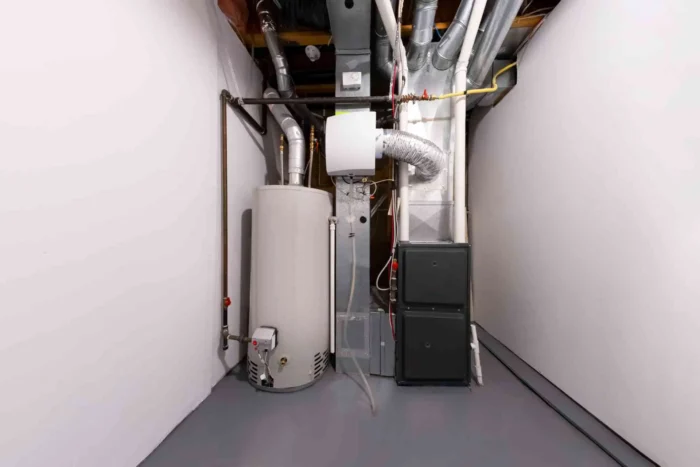
A lot of homeowners assume their furnace uses the same amount of electricity every time it runs. It doesn’t. Several factors quietly push that number up over time — and most of them are completely preventable. Here’s what we see most often in Denver homes:
Your Blower Motor Type Makes a Bigger Difference Than You’d Expect
This is the single biggest factor in how much electricity your furnace draws. Older PSC motors run at full power every single cycle — pulling 400 to 800 watts whether your home needs a little heat or a lot. There’s no in-between.
Modern ECM motors work completely differently. They adjust their speed based on what your home actually needs, often drawing as little as 200 watts on mild days. Over a full heating season in Denver, that difference can save you $50 to $150 in electricity costs alone. If your furnace is more than 10 years old, there’s a good chance it’s still running an old PSC motor.
Colder Climates Mean Longer Runtimes — And Higher Electrical Bills
The longer your furnace runs, the more electricity it uses — simple math. In Denver, furnaces regularly run 8 to 12 hours a day during January and February. At 700 watts, that’s 5.6 to 8.4 kWh per day just from the blower motor alone.
The problem is most homeowners only look at their gas usage when their bill spikes. The electricity side of the equation is just as real, especially during a polar vortex when your furnace barely shuts off.
Leaky Ducts and Poor Insulation Force Your Furnace to Run Longer
Here’s something we find constantly during service calls: the furnace itself is fine, but the home is losing heat faster than the furnace can replace it. Leaky ducts can waste 20 to 30% of your heated air before it ever reaches your living space. Poor wall or attic insulation does the same thing — heat escapes, the thermostat never gets satisfied, and the blower keeps running.
The result is longer cycles, more blower runtime, and a higher electricity draw — even though the furnace is technically working perfectly. If your furnace seems to run constantly, have your duct system inspected before assuming the furnace is the problem.
An Older, Poorly Maintained Furnace Works Harder Than It Should
Dust buildup on the blower wheel, a dirty heat exchanger, and worn components all add mechanical resistance to your system. That resistance translates directly into higher electrical draw — typically 10 to 25% more than a clean, well-maintained unit of the same size.
The fix is straightforward: annual professional maintenance and monthly filter changes during heating season. A furnace that’s properly maintained runs at its rated wattage. One that’s been ignored for two or three years is almost certainly pulling more electricity than the manufacturer ever intended.
Why Gas Furnaces Use Far Less Electricity Than Electric Heaters
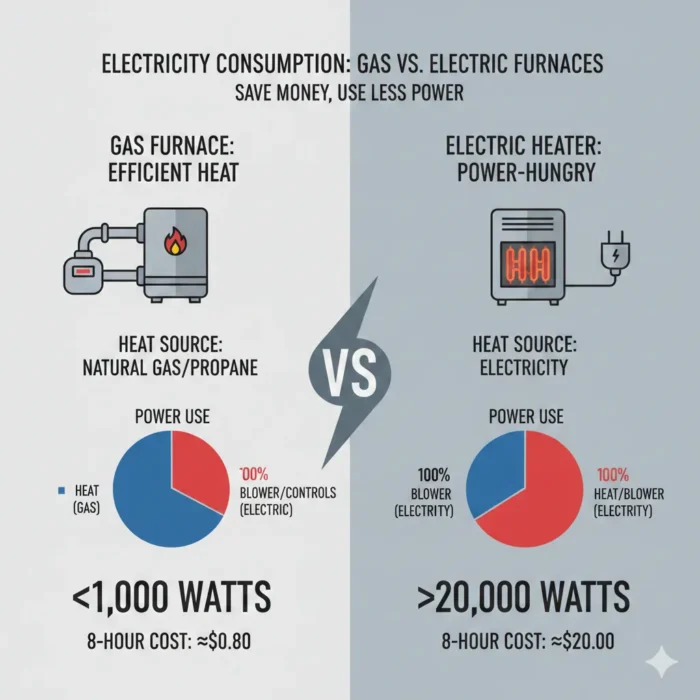
A common misconception is that all furnaces are power hogs. However, when calculating how many watts does a gas furnace use per day, the numbers are surprisingly low compared to electric-only units.
- Heat Source vs. Distribution: In an electric furnace, electricity is the fuel. It uses high-resistance coils (similar to a giant toaster) to create heat. In a gas furnace, natural gas or propane provides the thermal energy.
- The 90/10 Split: For a gas unit, electricity only handles the brains (control board) and the muscles (the blower). This is why a gas furnace typically stays under 1,000 watts, while an electric furnace can easily pull 20,000 watts.
- The Efficiency Gap: If you were to run a gas furnace and an electric furnace for the same 8-hour window, the gas unit would cost you roughly $0.80 in electricity, while the electric unit could cost over $20.00 depending on your local 2026 utility rates.
You may read How Long Does a Gas Water Heater Last?
AFUE vs. SEER and Why Blower Motor Type Matters for Electric Use
While AFUE (Annual Fuel Utilization Efficiency) measures how well your furnace converts gas into heat, it doesn’t tell the whole story about your electric bill. To understand the electrical draw, you have to look at the motor technology.
- PSC Motors (Old Tech): These are all or nothing motors. They pull high wattage (approx. 600–800W) regardless of whether your home needs a little heat or a lot.
- ECM Motors (Modern Tech): These Electronically Commutated Motors are the gold standard for 2026. They can ramp down their speed. On a mild day, an ECM motor might only pull 80 watts, significantly lowering the average of how many watts a furnace pulls over a 24-hour period.
- The SEER Connection: If you have a matching AC unit, a high-efficiency furnace blower (ECM) also improves your summer SEER rating by moving air more efficiently across the cooling coils.

How Your Location Affects How Many Watts Your Gas Furnace Uses Per Day
Most wattage guides give you a single number and call it a day. The truth is, where you live changes everything. A furnace in Miami running 3 hours a day and a furnace in Denver running 14 hours a day have the same wattage rating — but completely different electricity bills. Here’s what actually drives that difference:
The Cold Climate Penalty Is Real
Denver winters don’t mess around. During a polar vortex, your furnace can run 12 to 16 hours straight without a break — and that’s when your electricity bill takes a real hit. To put it in actual numbers:
- A 600W furnace running 16 hours consumes 9.6 kWh in a single day
- A 800W furnace running 16 hours consumes 12.8 kWh in a single day
- A 1,000W furnace running 16 hours consumes 16 kWh in a single day
That’s not a monthly number — that’s a single cold day in January. Multiply that across a full Denver winter and you start to see why electricity costs add up even on a gas system.
New Regulations Are Forcing Furnaces to Use Less Electricity
This is something most homeowners have no idea about. As of 2025, new regional efficiency standards heavily favor variable speed blowers over old single speed motors. ENERGY STAR certified gas furnaces must now meet strict Electrical Fan Power ratios — meaning the blower cannot waste electricity while the burners are off between heating cycles.
What this means for you practically:
- Older furnaces keep the blower running at full watts even during off cycles
- New ENERGY STAR models throttle down dramatically between cycles
- The result is a lower average daily wattage even if the peak wattage looks the same on paper
If your furnace was installed before 2020, it almost certainly doesn’t meet these standards — and you’re paying for it every month.
Short Cycling Is the Most Expensive Thing Your Furnace Can Do
Here’s something that surprises a lot of Denver homeowners: a furnace that turns on and off constantly costs more to run than one that runs in long steady cycles. Every single startup pulls a surge of 1,500 watts or more — that’s your gas furnace starting watts spiking well above normal operating wattage.
When a home has poor insulation or leaky walls, heat escapes faster than the furnace can replace it. The thermostat never gets fully satisfied, so the system short cycles — starting and stopping repeatedly throughout the day. Each of those startups hammers your electrical draw. Common causes we find in Denver homes include:
- Attic insulation below R-49 — the recommended level for Colorado’s climate
- Single pane windows that bleed heat out overnight
- Unsealed crawl spaces that let cold air undercut your floor
- Duct leaks losing 20 to 30% of heated air before it reaches your living space
If your furnace seems to run in short bursts rather than long steady cycles, the problem is almost never the furnace itself — it’s the building envelope around it. Fixing insulation and sealing ducts will do more for your electricity bill than any furnace upgrade.
Calculating Your Gas Furnace Electricity Cost
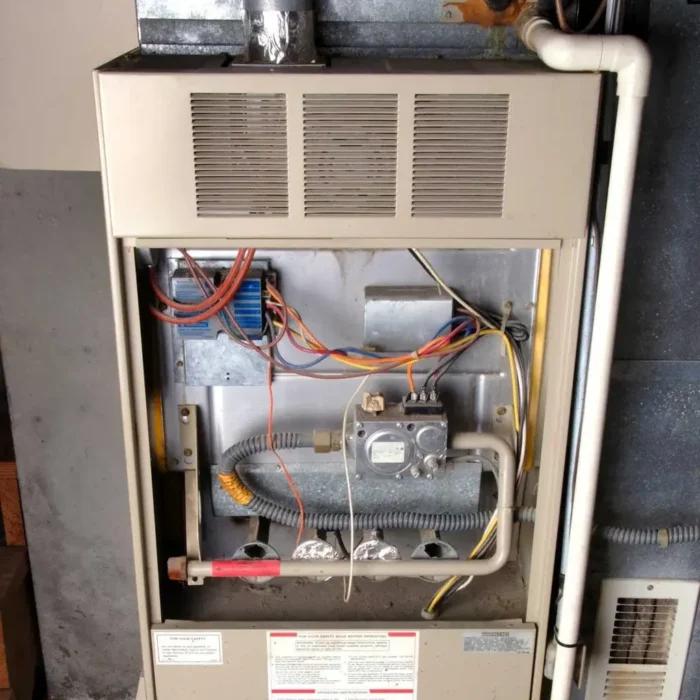
Knowing your actual costs helps with budgeting and generator planning.
Step 1: Find your furnace’s wattage rating on the data plate inside the blower compartment door. Look for voltage and amperage. Multiply these numbers together. A furnace running on 120 volts at 5 amps uses 600 watts.
Step 2: Estimate daily runtime hours. Most furnaces run 6-10 hours per day in winter.
Step 3: Calculate daily kilowatt-hours. Multiply wattage by hours and divide by 1,000. A 700-watt furnace running 8 hours uses 5.6 kWh daily (700W × 8 hours ÷ 1,000).
Step 4: Find your electricity rate on your utility bill. The national average is 17 cents per kWh. Denver residents typically pay 12-14 cents per kWh.
Step 5: Multiply daily kWh by your rate and days per month. That 5.6 kWh furnace costs about 76 cents daily at 13.6 cents per kWh. Over a 30-day month, that’s $22.80 just for the electrical portion.
| Daily Runtime | Monthly kWh (700W furnace) | Monthly Cost (14¢/kWh) |
| 6 hours | 126 kWh | $17.64 |
| 8 hours | 168 kWh | $23.52 |
| 10 hours | 210 kWh | $29.40 |
| 12 hours | 252 kWh | $35.28 |
Picking the Right Generator for Your Furnace
If the electricity fails during winter you won’t want to be left cold. A generator ensures your furnace operates when the power grid is, off.
What Size Is Necessary? Calculate your furnace’s wattage during operation. Then increase that by 25%. This additional margin accounts, for the power spike when the motor starts. For example with a 700-watt furnace your generator should supply least 875 watts.
What Individuals Truly Purchase:
- For furnaces using 400-600 watts opt for a generator rated, between 1,500 and 2,000 watts.
- Sized models that consume 600-900 watts—opt for 2,000 to 2,500 watts instead
- Larger furnaces, with 900-1,200 watts—ideally you need 3,000 to 3,500 watts
The majority of households manage well with a 2,000-watt generator. It can operate your furnace. Still provide sufficient power for a few lights and your refrigerator when the rest of the power is out.
If you want the whole house covered, standby generators start around 7,500 watts. These things kick on automatically when the power drops and can handle your entire electrical panel without you lifting a finger.
Two Myths About Gas Furnace Wattage We Hear All the Time
After years of service calls across Denver, these two misconceptions come up constantly — and both of them cost homeowners real money when left uncorrected:
“My gas furnace doesn’t use electricity” — Every modern furnace needs power for the igniter, blower, and control board. No electricity means no heat, even with a full gas line and a full tank. This is exactly why having a backup generator sized correctly for your furnace matters before winter hits.
“Higher wattage means more heat” — Wattage has nothing to do with how much heat your furnace produces. Heat output is measured in BTUs, determined by your gas input and AFUE efficiency rating — not electrical draw. The electricity just runs the support systems.
How to Reduce Furnace Energy Consumption
- Use a variable speed ECM motor
- Replace air filters every month
- Seal the duct leaks
- Install a small thermostat
- Schedule annual maintenance with professionals
When replacement time comes, Milehi Hvac offers furnace installation services in Denver with detailed energy savings analysis.
Conclusion
A typical gas furnace uses 400–1,200 watts of electricity with most homes averaging 600–800 watts during operation. This adds roughly $20–40 per month to winter electricity bills.
Knowing how many watts does a gas furnace use allows homeowners to budget accurately, select proper backup power and make informed efficiency upgrades. With proper maintenance and modern equipment, gas furnaces remain one of the most cost-effective heating solutions available.
Need expert help choosing an energy-efficient furnace? Contact Milehi Hvac for professional furnace installation services in Denver. We’ll help you find the perfect system to reduce costs and keep your home warm all winter.
FAQs
Will a 2000-watt generator run a gas furnace?
Yes, a 2000-watt generator handles most residential gas furnaces comfortably. Standard furnaces use 600-800 running watts with starting surges around 900-1,200 watts. This leaves enough capacity for a few lights and small appliances.
How many amps does a gas furnace use?
Gas furnaces typically draw 5-15 amps at 120 volts. Smaller units use 5-8 amps while larger systems with powerful blowers draw 10-15 amps. High-efficiency models with ECM motors often use fewer amps.
Can a gas furnace run without electricity?
No, modern gas furnaces cannot operate without electricity. They need power for the ignition system, blower motor, and safety controls. Even though natural gas provides the heat, electrical components are essential for safe operation.
Can a 3500 watt generator run a gas furnace?
Yes, a 3500-watt generator can run most gas furnaces since they mainly power the blower and controls. Make sure it can handle the furnace’s startup (surge) wattage.
Can I plug my gas furnace into a generator?
Yes, but only through a proper transfer switch or interlock for safety. Never plug directly into an outlet without approved electrical protection.
Will a 5000 watt generator run a gas furnace?
Yes, a 5000-watt generator can easily run a gas furnace and other essentials. It provides enough capacity for startup surges and additional appliances.